How Dentists Should Think About Automation Without Losing the Human Touch
By dentaiware · 2026-06-08
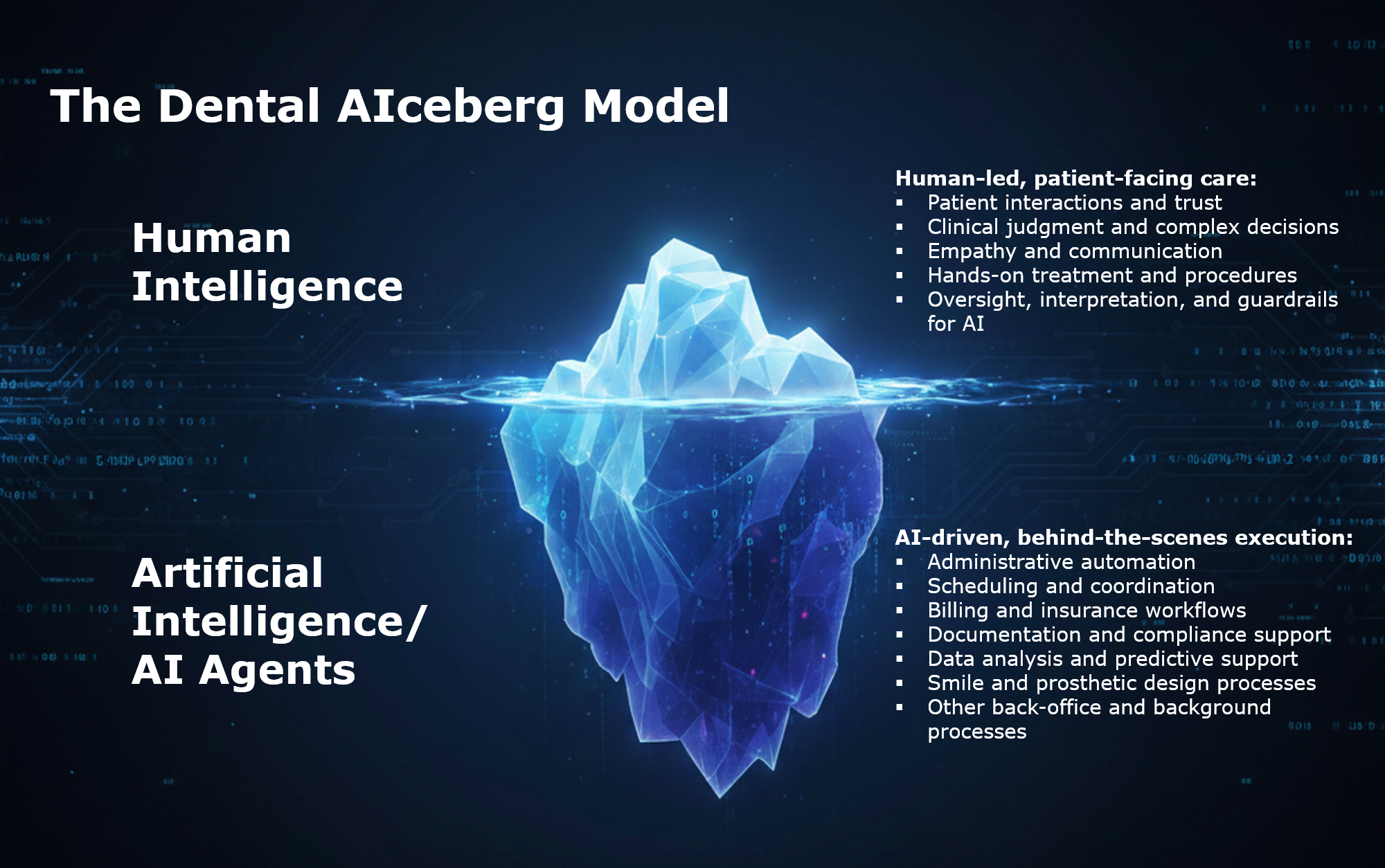
Automation in dentistry is not about replacing dentists. It is about removing friction so dental teams have more time and attention for the human moments that truly matter.
Automation in dentistry is often discussed as if it were a replacement story. Will AI replace dentists? Will chatbots replace reception teams? Will software replace clinical judgment?
I think this is the wrong way to look at it. The better question is: where can automation remove friction, so dental teams have more time, attention, and energy for the human moments that truly matter?
Dentistry Remains Deeply Human
Because dentistry is, and will remain, deeply human. Patients do not only come to a dental clinic for a diagnosis, a crown, or a treatment plan. They come with questions, concerns, expectations, fears, and trust. They need someone who listens, explains, reassures, and makes clinical decisions in their best interest.
That is the visible part of the iceberg: the dentist-patient relationship, clinical judgment, empathy, communication, and hands-on care. But below the surface, there is another reality. A large part of dental care depends on repetitive, fragmented, and often invisible work such as reminders, forms, documentation, billing, insurance workflows, follow-ups, treatment plan preparation, and internal coordination.
This is where automation can create real value. Not by replacing the dentist, but by supporting the clinic.
Automation Should Remove Friction
Good automation does not take the human touch out of dentistry. It protects it. Automated reminders can reduce no-shows and last-minute gaps in the schedule. Digital intake and consent forms can save time at the front desk and reduce manual data entry. AI-supported diagnostics can help highlight findings and support more consistent case discussions. Documentation tools can reduce the administrative burden after appointments. Follow-up workflows can make sure patients do not disappear after treatment recommendations.
None of these examples replace the need for a dentist. They simply make the system around the dentist work better. A patient who receives the right reminder at the right time is still cared for by the dental team. A patient who gets a clearer treatment plan explanation still needs a clinician to answer questions. A patient whose X-rays are supported by AI still needs a dentist to interpret the findings, explain the options, and make the final decision.
The Dentist Remains Responsible for Context
That distinction matters. AI can detect patterns. Software can organize information. Automation can trigger workflows. But the dentist remains responsible for context. A radiographic finding is not a treatment plan. A risk score is not a conversation. A generated explanation is not informed consent. A chatbot answer is not clinical trust.
This is especially important in complex cases, emotionally sensitive conversations, or situations where patient preferences, medical history, financial considerations, and clinical options all come together. Dentistry is not only about information. It is about judgment.
The Human Side Becomes the Differentiator
As automation becomes more common, the human side of dentistry may actually become a stronger differentiator. Patients will increasingly expect clinics to be digitally convenient, with online booking, smart reminders, digital forms, fast communication, transparent explanations, and seamless follow-ups. But convenience alone will not build loyalty. Trust will.
A clinic can use the most advanced AI tools and still feel cold, transactional, and disconnected. Another clinic can use automation quietly in the background while creating a calmer, more personal, and more attentive experience for the patient. The difference is not the technology itself. The difference is how the technology is implemented.
A Simple Rule for Dental Automation
A simple rule can help: automation should be used wherever work is repetitive, time-consuming, rules-based, or easy to forget. But it should be used carefully wherever emotional intelligence, clinical nuance, ethical judgment, or complex decision-making are required.
Before implementing any new automation tool, dental teams should ask one simple question: does this help us spend more meaningful time with patients, or does it create more distance?
If the answer is more meaningful time, the tool is probably moving in the right direction. If the answer is more distance, the clinic should be careful.
Human-Led Care, AI-Supported Execution
The future of dentistry is not human versus AI. It is about understanding where each one belongs. Human intelligence belongs in trust, empathy, communication, clinical judgment, and care. Artificial intelligence and automation belong in the background, helping with coordination, documentation, analysis, reminders, preparation, and repetitive workflows.
Above the surface, patients should still experience human-led care. Below the surface, automation can quietly make that care easier to deliver.
That is the real opportunity. Not replacing the dentist, but giving dentists and dental teams more space to do what only humans can do.