What the Dental AI & Software Market Map Tells Us About Where Dentistry Is Heading
By dentaiware · 2026-08-17
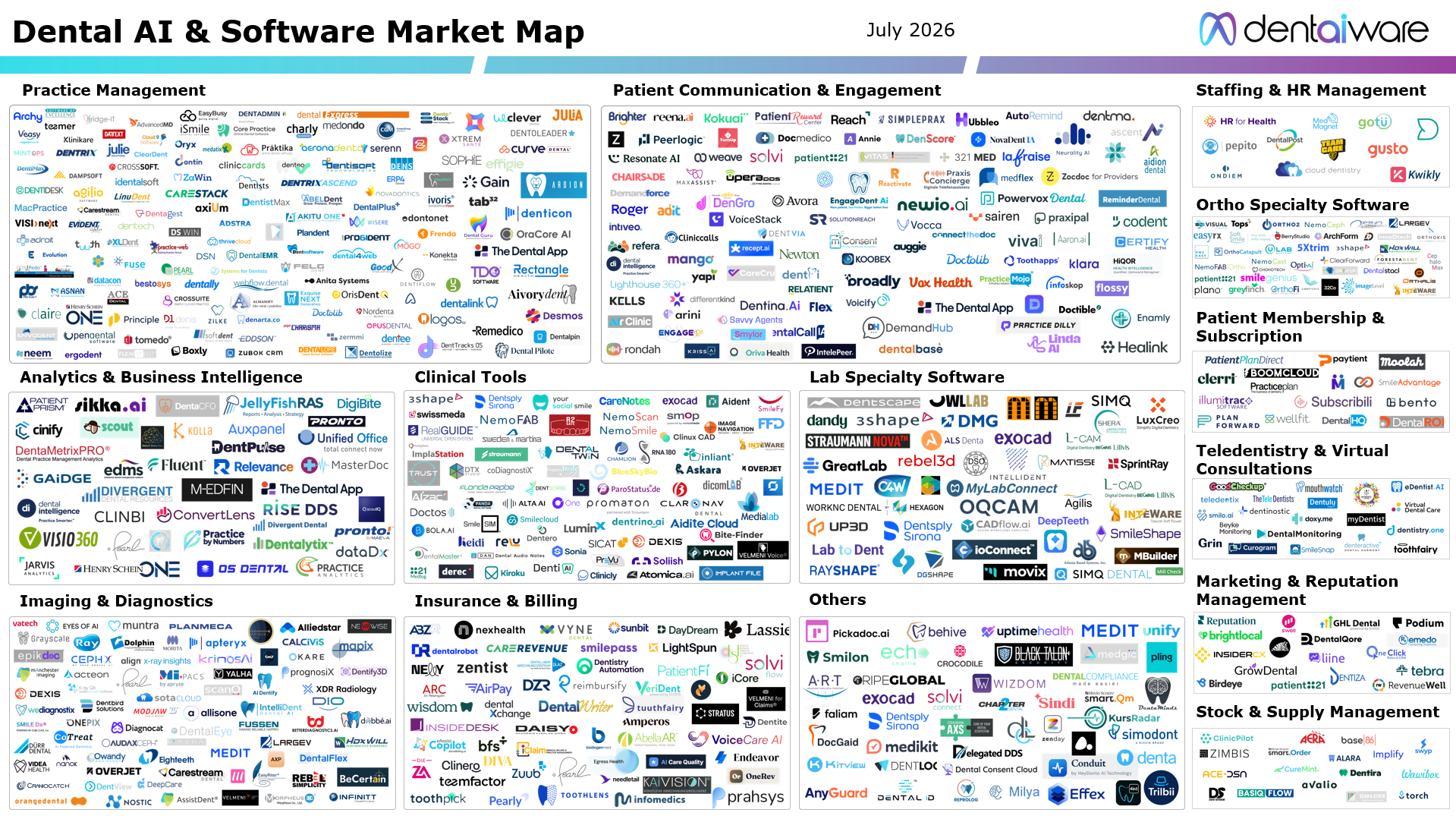
The latest Dental AI & Software Market Map covers more than 750 solutions worldwide. The most important signal is not the number, but the fact that AI is becoming infrastructure.
A few weeks ago, I published the latest version of the Dental AI & Software Market Map, now covering more than 750 solutions from around the world.
The number itself is striking. But what interests me much more is what the map tells us about where dentistry is heading.
For me, one trend stands out above all others:
AI is becoming infrastructure.
Not long ago, AI in dentistry was mostly discussed as a distinct category of technology - something associated with radiographic diagnostics, image analysis or a handful of specialized applications.
That is changing quickly.
Today, AI is increasingly embedded across the broader dental software landscape. It supports documentation, patient communication, scheduling, analytics, treatment planning, revenue cycle management, marketing, clinical decision support and many other areas.
In other words, we are moving away from a world of isolated "AI tools" toward one in which AI becomes a capability running underneath an increasing number of dental workflows.
A market becoming broader - and more complex
The Dental AI & Software Market Map makes this development visible.
Innovation is no longer concentrated in a few areas. New solutions are appearing across almost every part of running and delivering dental care.
That is exciting.
Many long-standing problems in dentistry - manual administrative work, fragmented communication, inefficient processes, underused data - can now be addressed in ways that simply were not possible a few years ago.
But rapid innovation also creates complexity.
For dental professionals, the challenge is increasingly not whether technology exists. It is understanding which technology matters, where it fits and what problem it actually solves.
A practice or DSO does not need more software simply because more software exists. And it does not need AI simply because AI is available.
The starting point should always be the problem. What are we trying to improve? Where are we losing time? Where does the patient experience break down? Which processes are still unnecessarily manual? Where would better information lead to better decisions?
Technology should follow those questions.
Why I started building dentaiware
This growing complexity was one of the main reasons I started building dentaiware.
The initial idea was simple: create transparency in a rapidly expanding market by identifying solutions, structuring them and making the landscape easier to understand.
The more the market grows, however, the clearer it becomes that simply listing solutions will not be enough.
Over time, I want dentaiware to help connect technology more closely to the way dentistry is actually delivered - across patient journeys, clinical workflows and back-office processes.
Instead of starting with the question:
"What software is out there?"
the better question will increasingly be:
"What challenge are we trying to solve - and which technologies could help us do it?"
That is still part of the journey ahead, but I believe it is an important direction for the industry.
A snapshot of a market that never stands still
The current Dental AI & Software Market Map includes more than 750 solutions.
There will be more. Some companies will disappear. Others will consolidate. Platforms will expand into new areas. And AI will increasingly become less visible as a separate category because it will simply become part of the infrastructure underneath the software we use every day.
That is why I do not see the map as a finished picture. It is a snapshot of a market that never stands still.
And as the dental technology landscape continues to expand, the real competitive advantage will not come from using the most technology.
It will come from understanding where technology creates meaningful value - for dental teams, organizations and ultimately for patients.